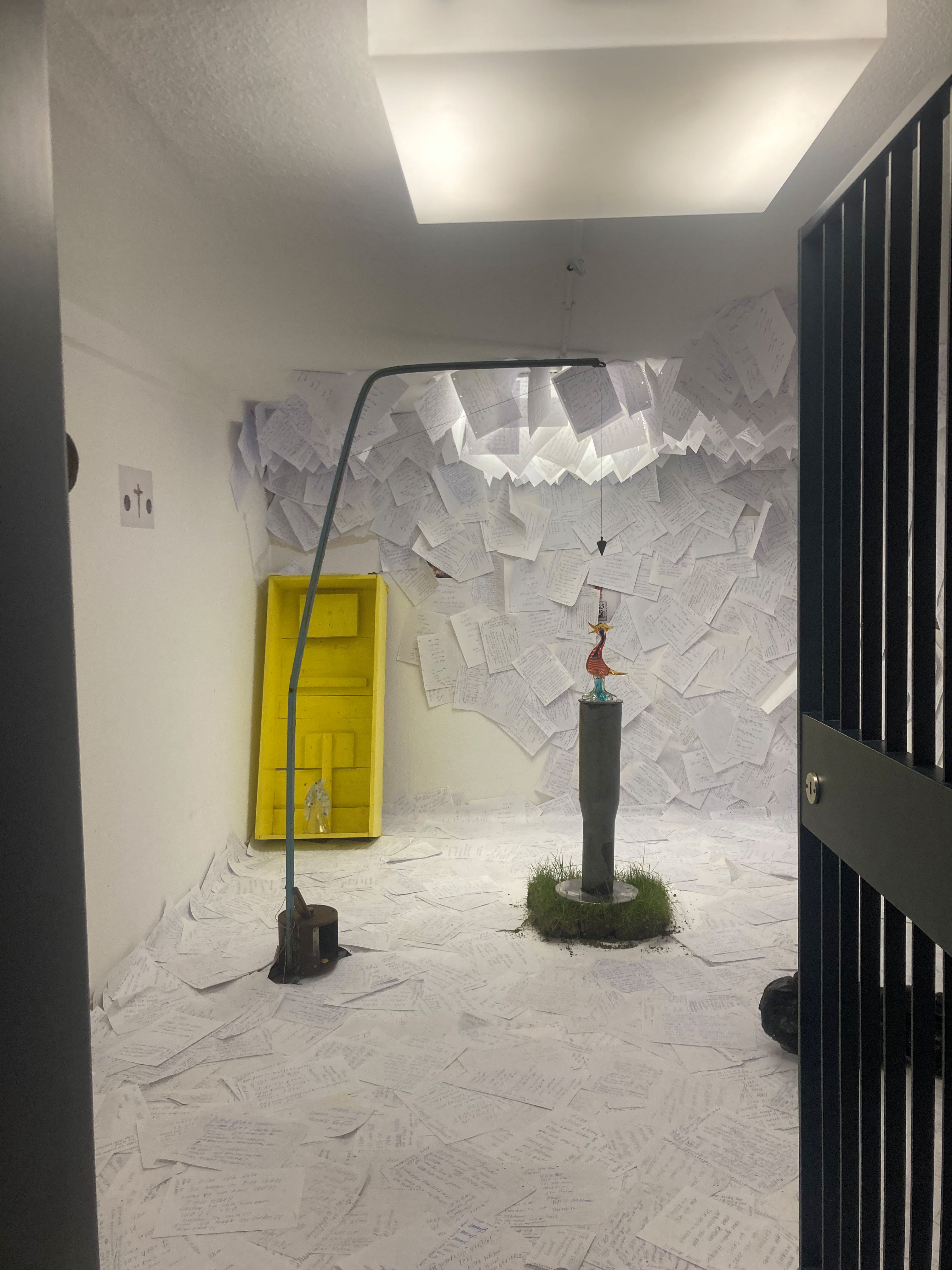
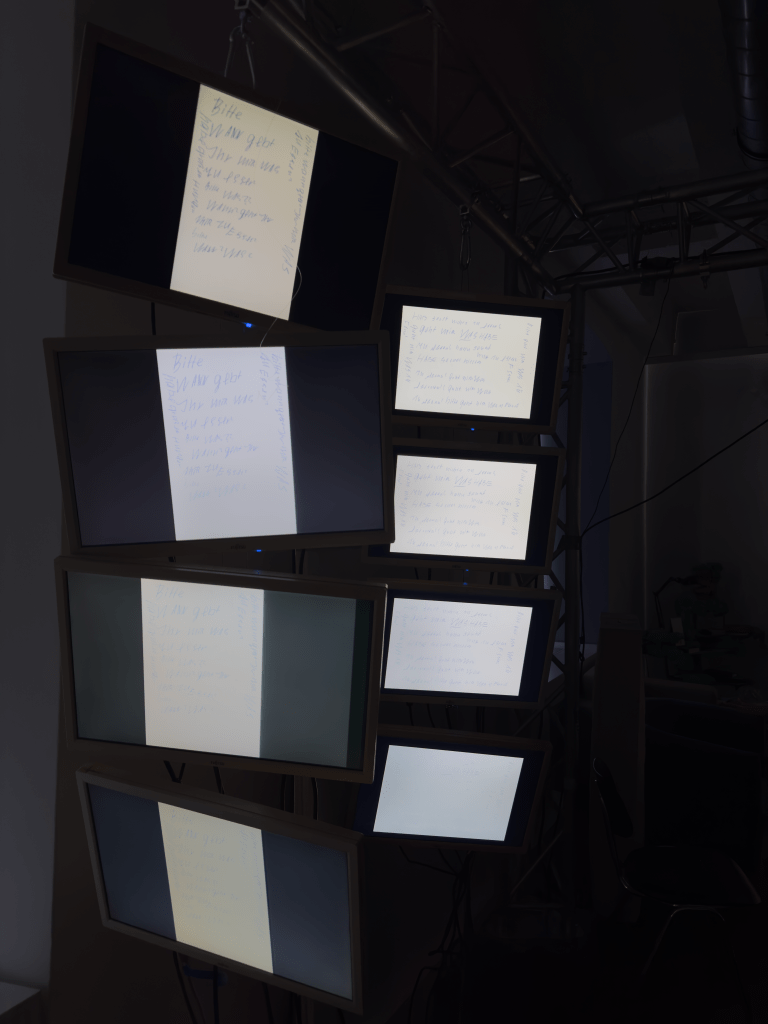
“Im Lot” was originally a room installation by artist Josef Hamberger from Rosenheim.
The installation primarily consisted of notes written by a severely dementia-affected
woman. Josef Hamberger, who also works as an elder-care nurse, observed with his
team, as his patient’s illness progressed, the calming effect that writing had on her.
However, over time, the patient developed an intense compulsion to write, which
resulted in hundreds of notes each day. Through these notes, the nursing home
resident offered an intimate glimpse into her inner world and the cruelty of her illness.
Fascinated by this unique material, Josef Hamberger began to randomly take a few
notes back to his studio over the years. After the woman’s death, the artist
transformed these notes into the powerful room installation “Im Lot”. This installation
provides a deeply personal insight into the woman’s thoughts, her life, and the
progression of this brutal illness.
Impressed by Hamberger’s work, media artist Noayama developed a concept to
transfer “Im Lot” into the digital realm. Partly out of concern for the material’s fragility,
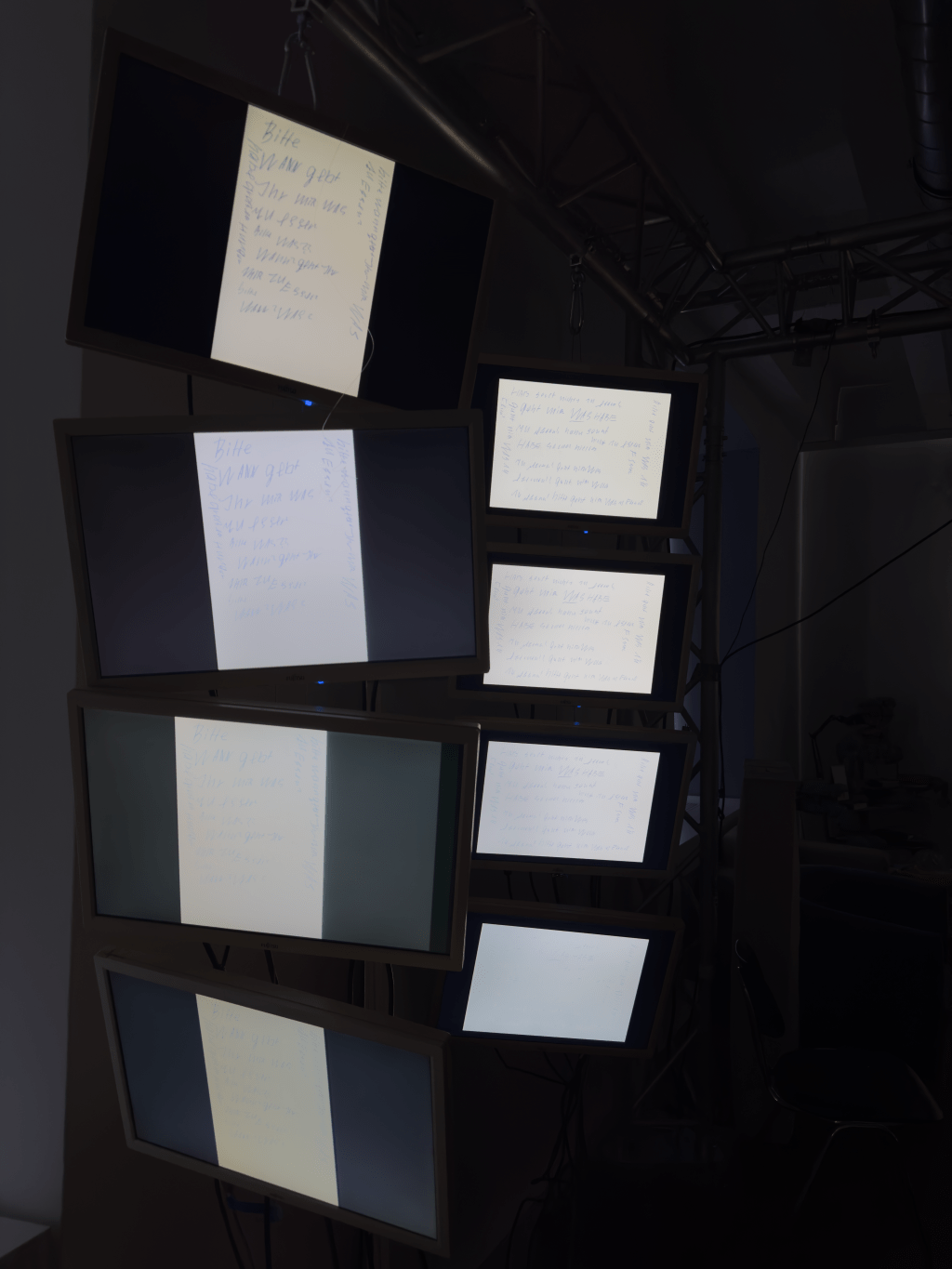
he decided to scan all the notes. These scans are displayed on two rows of hanging
monitors. Noayama plays the scans as video at varying speeds, bringing the chaotic
and flowing nature of the woman’s mind to life. Fully aware of the intensity of this
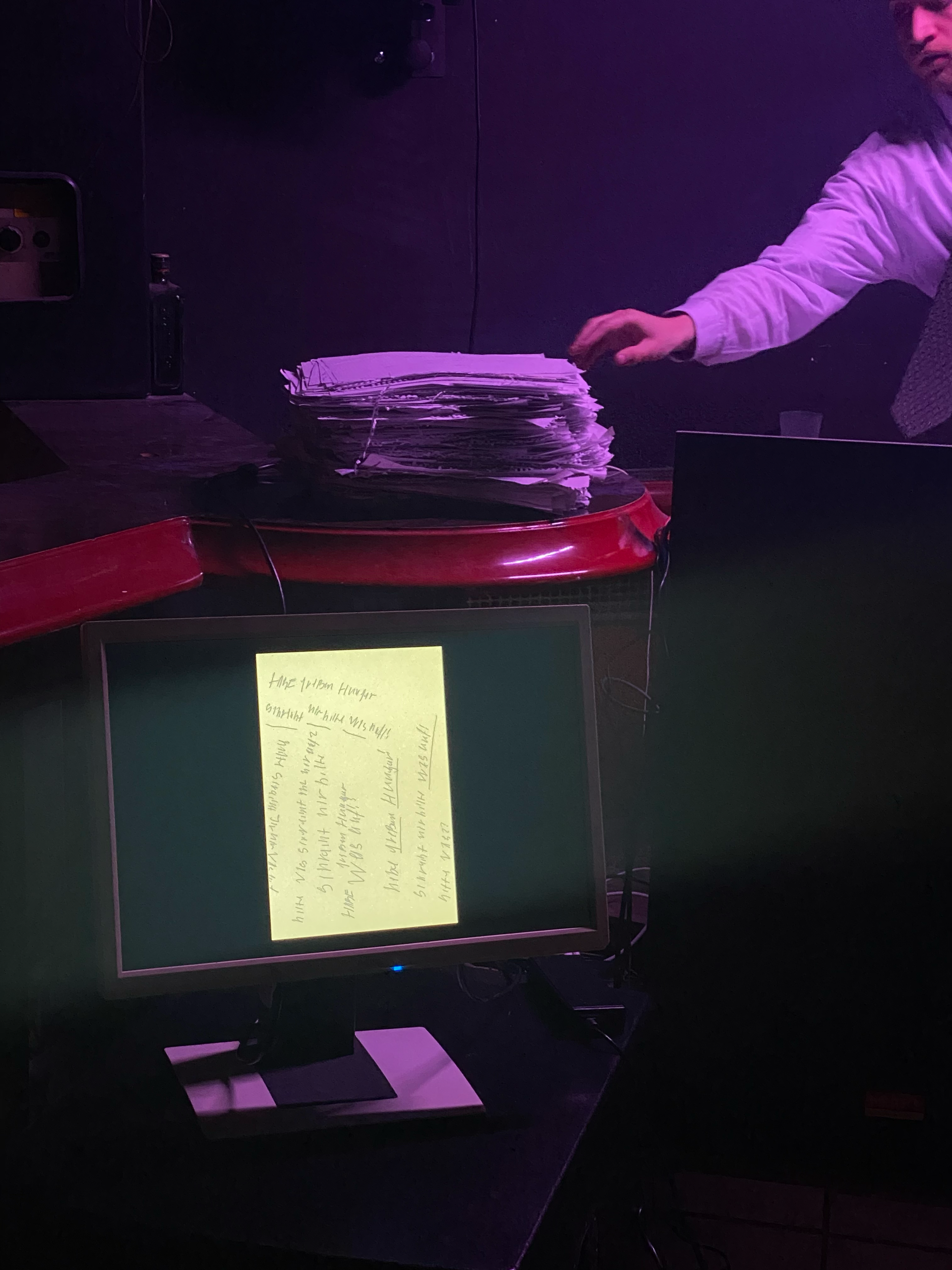
work, the 22-year-old artist decided to also present the original notes in a neutral
folder. This allows viewers to grasp the sheer volume of the notes and engage with the
material in a more detailed and focused way.
Artistic Statement
“Im Lot“ was originally a spatial installation by the artist and eldercare worker Josef
Hamberger from Rosenheim, which delves deeply into the experiential world of a
woman suffering from advanced dementia. The installation mainly consisted of notes
written by this resident of a nursing home, who was compelled to write incessantly.
Josef Hamberger, who works closely with the mental state of his patients as a
caregiver, observed with his team how writing had a calming, almost therapeutic effect
on the patient. However, as the disease progressed, a compulsion to write developed,which led the woman to produce hundreds of notes daily. These notes are
fragmented, often repetitive thoughts, offering insights into her inner world and the
relentless cruelty of her illness. Fascinated by this unique form of self-expression,
Hamberger began taking some of the notes back to his studio over the years. After
the woman’s death, he created the powerful spatial installation *”Im Lot”*, which
immerses the viewer in her deepest thoughts and life, while also making the merciless
nature of her disease tangible.
The young media artist Noayama was deeply impressed by Hamberger’s work. In his
view, *”Im Lot”* has an extraordinary intensity that makes the process of remembering
and forgetting disturbingly palpable. Due to the overwhelming nature of the material,
Noayama decided to transfer the work into the digital realm, developing a new
concept that emphasizes the ephemeral character of the original material while also
preserving it. The fragility and fading of the handwritten notes in paper form inspired
him to scan them, preserving the essential depth of these documents in a new form.
Noayama decided to present the digital scans of the notes on two rows of hanging
monitors, arranged like a visual data stream. The scans are played back as videos at
varying speeds to make the sense of uncontrollability and chaos that characterized
the woman’s thought process visually tangible. Through the changing speeds, viewers
are placed in a kind of trance that reflects the restless and fleeting thoughts of the
nursing home resident. The digital repetition and continuous flickering of the content
amplify the fragmentation and disintegration that Noayama perceives as the central
theme of *”Im Lot”*. Noayama is also aware that transferring the work to the digital
medium does not guarantee the eternal preservation of the information. This
awareness is expressed through his choice of monitors. Although identical in
construction, the monitors appear fragile and “yellowed” through wear and tear,
suggesting age and experience. Noayama believes they somehow “seem human.”
From an artistic perspective, Noayama engages deeply with the concept of memory
and loss. By digitizing the original analog installation, he creates not only an archive
but also an expansion that transforms and deepens the original work. For him, the
digital transfer reflects our modern world, where memories and personal experiences
are increasingly captured in digital storage spaces and data streams, becoming in a
sense alienated. The fleeting sequences on the monitors evoke the decay and
fragmentation of identity in a technologized society, where human memory and
emotional depth often vanish in the infinity of digital reproductions and copies.
Noayama is acutely aware of the intensity and emotional weight of this work.
Therefore, he decided to make the original handwritten notes available in a neutral,
factual binder. This allows viewers to grasp the actual quantity of the notes and
physically sense the urgency of the writing. This contrast between the digital
presentation and the tangible original material enhances the work’s statement: The
transience of the body and mind stands in tension with the supposed permanence of
the digital, which is equally fragile and fleeting.Through this design, Noayama invites the viewer to reflect on how we handle memory,
identity, and loss in an increasingly digital world. He subtly questions what it means to
preserve memories when they exist in countless copies, yet remain far removed from
lived experience. The work reminds us that behind the scanned notes, there is a real,
fragile human existence, whose inner world no longer holds the same intimacy in the
digital realm. Noayama’s digital transfer of *”Im Lot”* is therefore not just a
preservation of the material but a reflection on the human need to position and
understand oneself in an increasingly technologized world.
 noayama.org