
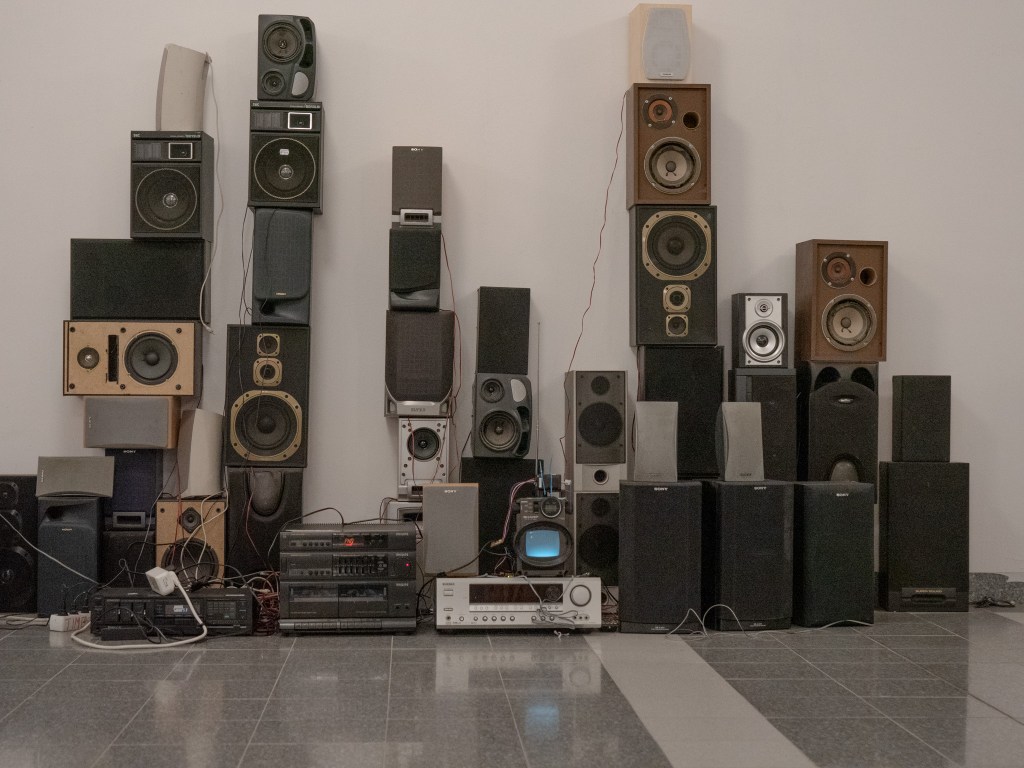
Plain Receiver” offers a serious critique of the system, almost wrapped in a comedic guise. The television in the center, though also an “Objet Trouvé,” clearly stands out from the rest of the objects due to its positioning. Naturally, the artwork centers around the television, both because of its sounds and its luminescence.
Despite their numerical superiority, the speakers play a subordinate role. Almost all of them are directed at the television and relay everything it broadcasts, even if it’s just meaningless static. They stand like an army behind their general.
When one closely examines the mechanism on the TV’s tuner and the minimal changes on the screen, it is reminiscent of swiping (doomscrolling on social media) or the generally monotonous world of computers (Excel spreadsheets, trading graphs, etc.).
The artwork thus reflects the injustice and unequal distribution of power, as it is also present in today’s techno-capitalism. Scandals like the “Facebook-Cambridge Analytica Data Scandal” have shown the power algorithms and the corporations that control them have over societies. “Plain Receiver” is therefore an attempt to artistically capture this complex system. The work also depicts the vulnerability and powerlessness of people against these algorithms. Just as we need algorithms to manage our modern lives, the speakers need the television to infuse sound and life. This entanglement may not be resolvable, but perhaps it can be better controlled.
 noayama.org